
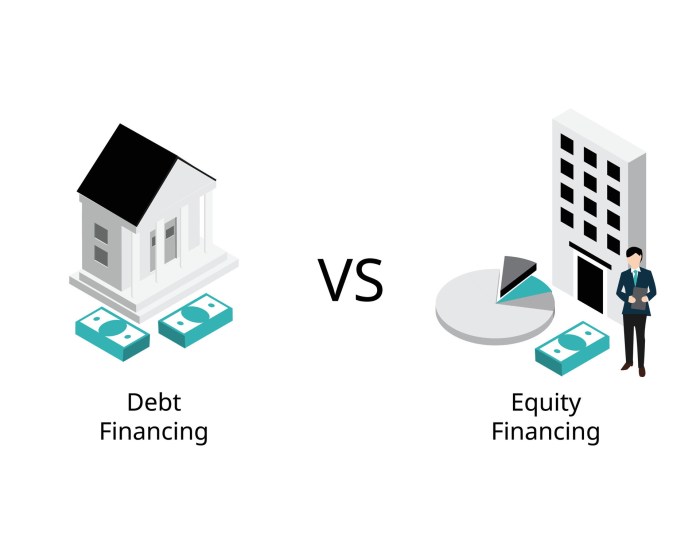
Exploring the age-old debate of Debt Financing vs Equity Financing: Which Is Better for Entrepreneurs?, we delve into the intricacies of financial decisions that can make or break a business. This comparison sheds light on the nuances entrepreneurs face when choosing between these two vital funding options.
Providing a comprehensive breakdown of debt financing and equity financing, this discussion aims to equip entrepreneurs with the knowledge needed to navigate the complex world of business finance.
Introduction to Debt Financing and Equity Financing
Debt financing and equity financing are two primary methods that entrepreneurs can use to raise funds for their businesses. Debt financing involves borrowing money that must be repaid over time with interest. This can be in the form of loans, bonds, or lines of credit.
On the other hand, equity financing involves selling a stake in the company in exchange for funds. This can come from angel investors, venture capitalists, or through an initial public offering (IPO).
Differences between Debt Financing and Equity Financing
- Debt Financing:
- Requires repayment with interest
- Does not involve giving up ownership stake
- Can be secured or unsecured
- Equity Financing:
- Does not require repayment
- Involves giving up ownership stake
- Investors share in the company's profits and losses
Examples of When Each Type of Financing is Typically Used
- Debt Financing:
- Used for short-term capital needs
- Common for businesses with steady cash flow
- Can be used to finance specific projects
- Equity Financing:
- Often used by startups with high growth potential
- Good for businesses with uncertain cash flow
- Can provide access to expertise and networks of investors
Pros and Cons of Debt Financing
Debt financing can be a valuable tool for entrepreneurs looking to fund their business ventures, as it offers both advantages and disadvantages that need to be carefully considered.
Advantages of Debt Financing for Entrepreneurs:
- Immediate access to funds: Debt financing provides quick access to capital, allowing entrepreneurs to seize opportunities or address urgent financial needs.
- Maintain ownership control: Unlike equity financing, taking on debt does not require giving up ownership stakes in the business, allowing entrepreneurs to retain full control.
- Tax benefits: The interest paid on business loans is often tax-deductible, reducing the overall tax liability for the company.
- Predictable repayments: Debt financing usually comes with fixed repayment schedules, making it easier for entrepreneurs to budget and plan for the future.
Disadvantages of Debt Financing for Entrepreneurs:
- Interest payments: Borrowing money comes with the cost of interest payments, which can add up over time and increase the overall financial burden on the business.
- Risk of default: If the business is unable to make timely repayments, it could lead to default, damaging the company's credit rating and potentially resulting in legal action.
- Limited cash flow: Debt repayments can place strain on the company's cash flow, limiting its ability to invest in growth opportunities or cover unexpected expenses.
- Collateral requirements: Some lenders may require collateral to secure the loan, putting personal or business assets at risk if the loan cannot be repaid.
Real-life Scenarios Where Debt Financing May Be the Best Option:
In certain situations, debt financing can be the most suitable choice for entrepreneurs. For example, if a business has steady cash flow and a clear plan for repayment, taking on debt can provide the necessary capital to expand operations, purchase equipment, or fund a new project.
Additionally, if the entrepreneur wants to maintain full ownership of the business and is comfortable with the risk of debt, opting for a loan rather than seeking investors may be the preferred route.
Pros and Cons of Equity Financing
When it comes to funding a startup or expanding a business, equity financing can be a viable option for entrepreneurs. However, it also comes with its own set of advantages and disadvantages that need to be carefully considered.
Benefits of Equity Financing for Startups and Entrepreneurs
- Access to Capital: Equity financing allows entrepreneurs to raise significant amounts of capital without taking on debt, providing the financial resources needed to grow the business.
- Expertise and Networks: Equity investors often bring valuable expertise, experience, and industry connections to the table, helping startups with strategic guidance and business development.
- Shared Risk: Unlike debt financing, equity investors share the risks of the business, as they only profit when the company succeeds, aligning their interests with the entrepreneurs.
- No Repayment Obligations: With equity financing, there are no fixed repayment schedules or interest payments, allowing the business to focus on growth without the pressure of meeting financial obligations.
Drawbacks of Equity Financing
- Dilution of Ownership: By selling equity in the company, entrepreneurs give up a portion of ownership and control, potentially leading to conflicts over decision-making and strategic direction.
- Loss of Profits: Equity investors are entitled to a share of the profits, which means that entrepreneurs may have to give up a portion of the company's earnings in the long run.
- Complex Valuation: Determining the value of the company and negotiating equity deals can be complex and time-consuming, requiring professional expertise and careful consideration.
- Exit Strategy Pressure: Equity investors typically expect a profitable exit within a certain timeframe, putting pressure on entrepreneurs to meet growth targets and deliver returns.
Long-Term Implications of Equity Financing vs. Debt Financing
Equity financing offers the advantage of shared risk and access to expertise, but it comes with the trade-off of dilution of ownership and profit sharing. In contrast, debt financing allows entrepreneurs to retain full ownership but comes with the obligation of repayment and interest costs.
Ultimately, the decision between equity and debt financing depends on the specific needs and goals of the business, as well as the risk tolerance of the entrepreneurs involved.
Decision-Making Factors for Entrepreneurs
When deciding between debt and equity financing, entrepreneurs must carefully evaluate a variety of factors to determine the best option for their business. These factors can significantly impact the company's financial health, growth prospects, and overall success.
Company Stage
The stage of the company plays a crucial role in determining the most suitable financing option. Early-stage startups with limited assets and revenue may find it challenging to secure debt financing, as lenders often require collateral or a proven track record of profitability.
In contrast, equity financing can be more accessible for startups, as investors are willing to take on higher risks in exchange for potential high returns.
Growth Projections
Entrepreneurs need to consider their company's growth projections when deciding between debt and equity financing. If the business has strong growth potential and expects to generate substantial profits in the future, equity financing may be the better choice. On the other hand, if the company has stable cash flow and can easily service debt payments, debt financing could be a more cost-effective option.
Risk Tolerance
Another crucial factor for entrepreneurs to consider is their risk tolerance. Debt financing involves taking on a fixed obligation to repay the borrowed amount with interest, regardless of the company's performance. In contrast, equity financing does not require immediate repayment but involves sharing ownership and potential profits with investors.
Entrepreneurs must assess their risk tolerance and financial stability to choose the financing option that aligns with their long-term goals.
Case Studies and Examples
In this section, we will delve into specific case studies and examples of businesses that have successfully utilized debt financing and equity financing to highlight the outcomes of each approach.
Successful Businesses with Debt Financing
- One notable example of a successful business that leveraged debt financing is XYZ Company. By taking out loans to fund their expansion projects, XYZ Company was able to grow rapidly without diluting ownership.
- Another case study is ABC Corporation, which used debt financing to launch a new product line. This strategic move helped them increase market share and revenue without giving up equity.
Companies Benefiting from Equity Financing
- On the other hand, DEF Inc. is a prime example of a company that flourished with equity financing. By bringing in investors who provided capital in exchange for ownership stake, DEF Inc. was able to scale their operations and enter new markets.
- Similarly, GHI Ventures secured significant funding through equity financing, allowing them to innovate and develop cutting-edge technologies that propelled their growth and competitiveness in the industry.
Comparing Outcomes
- When comparing businesses that chose debt financing versus equity financing, it is evident that both approaches have their advantages and limitations. Debt financing offers flexibility and control over the company's operations, while equity financing provides access to valuable expertise and resources.
- While companies like XYZ Company and ABC Corporation thrived with debt financing, DEF Inc. and GHI Ventures achieved remarkable success through equity financing. The choice between debt and equity financing ultimately depends on the business's goals, risk tolerance, and growth strategy.
End of Discussion
In conclusion, the decision between debt and equity financing boils down to a myriad of factors that must be carefully weighed by entrepreneurs. By understanding the pros and cons of each option, entrepreneurs can make informed choices that pave the way for sustainable business growth and success.
FAQ Corner
What are the main differences between debt financing and equity financing?
Debt financing involves borrowing funds that need to be repaid with interest, while equity financing involves selling ownership stakes in the company in exchange for capital.
What are the advantages of debt financing for entrepreneurs?
Debt financing allows entrepreneurs to retain full ownership and control of their business, and interest payments are tax-deductible.
What are the benefits of equity financing for startups?
Equity financing provides access to capital without incurring debt, and investors share the risks and rewards of the business.
How do entrepreneurs decide between debt and equity financing?
Entrepreneurs should consider factors like their risk tolerance, growth projections, and the stage of their company when making the decision.