
Embark on the journey of understanding Revenue Based Financing Calculator: How to Estimate Your Repayment. This introduction sets the stage for exploring the intricacies of estimating repayment terms with precision and insight.
Delve into the details of Revenue Based Financing and its impact on businesses, unlocking the potential of financial planning and growth.
Introduction to Revenue-Based Financing Calculator
Revenue-Based Financing (RBF) is a funding option for businesses where repayment is based on a percentage of monthly revenue. This alternative to traditional loans is gaining popularity due to its flexible repayment structure and alignment with cash flow.A Revenue-Based Financing Calculator is a tool that helps businesses estimate their repayment terms based on projected revenue and other key factors.
By inputting data such as the amount funded, revenue share percentage, and the term length, businesses can get a clear picture of their repayment schedule.
Key Components of Using the Calculator
- Amount Funded: This is the total amount of funding received from the RBF investor.
- Revenue Share Percentage: The percentage of monthly revenue that will be used for repayment.
- Term Length: The duration over which the funding will be repaid, typically expressed in months.
- Projected Revenue: An estimate of the business's future revenue, which is crucial for calculating repayment amounts.
Understanding Revenue-Based Financing
Revenue-Based Financing (RBF) is a type of funding for businesses where the repayment amount is based on a percentage of the company's monthly revenue. This means that as the business generates more revenue, the repayment amount increases, and conversely, if revenue decreases, the repayment amount decreases as well.RBF differs from traditional loans in several key ways.
Unlike traditional loans, RBF does not require fixed monthly payments. Instead, the repayment amount is directly tied to the company's revenue, making it more flexible and aligned with the business's cash flow. Additionally, RBF investors do not take equity in the company, allowing the business to maintain ownership and control.One of the main benefits of Revenue-Based Financing for businesses is the flexibility it offers in repayment.
Since the repayment amount is based on a percentage of revenue, businesses do not face the same financial strain during slow months or seasons. This can be especially beneficial for businesses with fluctuating revenue streams or seasonal sales cycles.
Comparison between Revenue-Based Financing and Traditional Loans
- RBF does not require fixed monthly payments, unlike traditional loans.
- RBF repayment is directly tied to the company's revenue, making it more flexible.
- RBF investors do not take equity in the company, allowing the business to maintain ownership and control.
Components of a Revenue-Based Financing Calculator
Revenue-Based Financing (RBF) calculators are essential tools for estimating repayment amounts based on a company's revenue. These calculators require specific inputs to generate accurate repayment estimates and help businesses make informed decisions.
Essential Inputs for Calculating Repayment Estimates
- Loan Amount: The total amount of financing received by the business.
- Repayment Percentage: The percentage of monthly revenue that will go towards repayment.
- Revenue Growth Rate: The expected rate at which the company's revenue will grow over time.
- Term Length: The duration of the repayment period.
Formula Used in Revenue-Based Financing Calculations
Monthly Repayment Amount = Loan Amount x Repayment Percentage
This formula calculates the monthly repayment amount based on the loan amount and repayment percentage agreed upon in the RBF terms.
Impact of Different Variables on Repayment Amounts
Various factors can influence the repayment amounts in Revenue-Based Financing:
- Loan Amount:A higher loan amount will result in higher monthly repayment amounts.
- Repayment Percentage:A lower repayment percentage can reduce monthly repayment amounts, making it more manageable for the business.
- Revenue Growth Rate:Higher revenue growth can lead to increased repayment amounts as the business generates more income.
- Term Length:Longer repayment terms may result in lower monthly payments but could lead to higher overall repayment amounts due to interest.
How to Use a Revenue-Based Financing Calculator
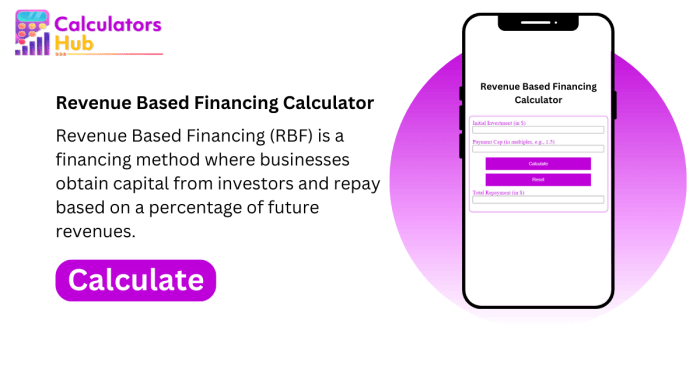
To effectively utilize a Revenue-Based Financing Calculator, follow these step-by-step guidelines and tips for accurate estimation:
Step-by-Step Guide
- 1. Input your company's annual revenue: Provide the total revenue generated by your business in a year.
- 2. Enter the desired advance rate: Specify the percentage of your annual revenue you are willing to advance.
- 3. Determine the factor rate: This is the multiplier used to calculate the total repayment amount.
- 4. Set the term length: Choose the duration in which you plan to repay the financing.
- 5. Calculate the estimated repayment: The calculator will generate an estimate based on the input data.
Tips for Accurate Data Input
- 1. Ensure precise revenue figures: Use accurate and up-to-date financial statements for input.
- 2. Double-check advance rates: Confirm the percentage you are comfortable advancing to avoid errors.
- 3. Understand the factor rate: Be clear on how this rate affects the total repayment amount.
- 4. Consider term length carefully: Choose a repayment period that aligns with your business's cash flow.
Common Mistakes to Avoid
- 1. Inaccurate revenue data: Incorrect revenue figures can lead to flawed estimates.
- 2. Misinterpreting advance rates: Misunderstanding the advance rate can result in unrealistic repayment expectations.
- 3. Neglecting the factor rate impact: Not considering the factor rate's influence can lead to unexpected repayment amounts.
- 4. Ignoring term length relevance: Choosing an unsuitable term length may affect your business's financial stability.
Interpreting Results from the Calculator
When using a Revenue-Based Financing Calculator, it is essential to understand how to interpret the results it generates. The repayment schedule provided by the calculator gives you a breakdown of how much you will need to repay over time based on your revenue projections and the terms of the financing.
Repayment Schedule Breakdown
- The repayment schedule typically includes details such as the total amount to be repaid, the monthly repayment amount, the percentage of revenue to be paid, and the duration of the repayment period.
- It is important to analyze the repayment schedule to ensure that your business can comfortably meet the repayment obligations without straining cash flow.
- Understanding the repayment schedule allows you to plan ahead and make informed decisions about taking on revenue-based financing.
Financial Health Assessment
- The results generated by the calculator can provide insights into the financial health of your business.
- If the repayment amounts seem manageable and align with your revenue projections, it indicates that your business is in a good position to take on financing.
- On the other hand, if the repayment amounts appear too high or unsustainable based on your revenue estimates, it may signal financial challenges that need to be addressed before pursuing financing.
Adjusting Repayment Estimates
- It is important to consider different scenarios and adjust repayment estimates accordingly.
- If your revenue projections change, you can use the calculator to see how repayment amounts vary based on different revenue figures.
- By adjusting repayment estimates, you can assess the impact on your cash flow and make informed decisions about the feasibility of revenue-based financing for your business.
Summary
Concluding our discussion on Revenue Based Financing Calculator: How to Estimate Your Repayment, we reflect on the key takeaways and insights gained. Dive into the world of financial estimation with confidence and knowledge.
Commonly Asked Questions
How do I interpret the results from the calculator?
Results from the calculator provide a detailed repayment schedule, offering insights into the financial health of your business and guiding adjustments for different scenarios.
What are the key components involved in using the calculator?
Essential inputs, the formula for calculations, and understanding how variables affect repayment amounts are crucial components in utilizing the calculator effectively.
Can you explain the benefits of Revenue-Based Financing for businesses?
Revenue-Based Financing offers a unique approach compared to traditional loans, providing businesses with flexible repayment structures and alignment with revenue streams.